

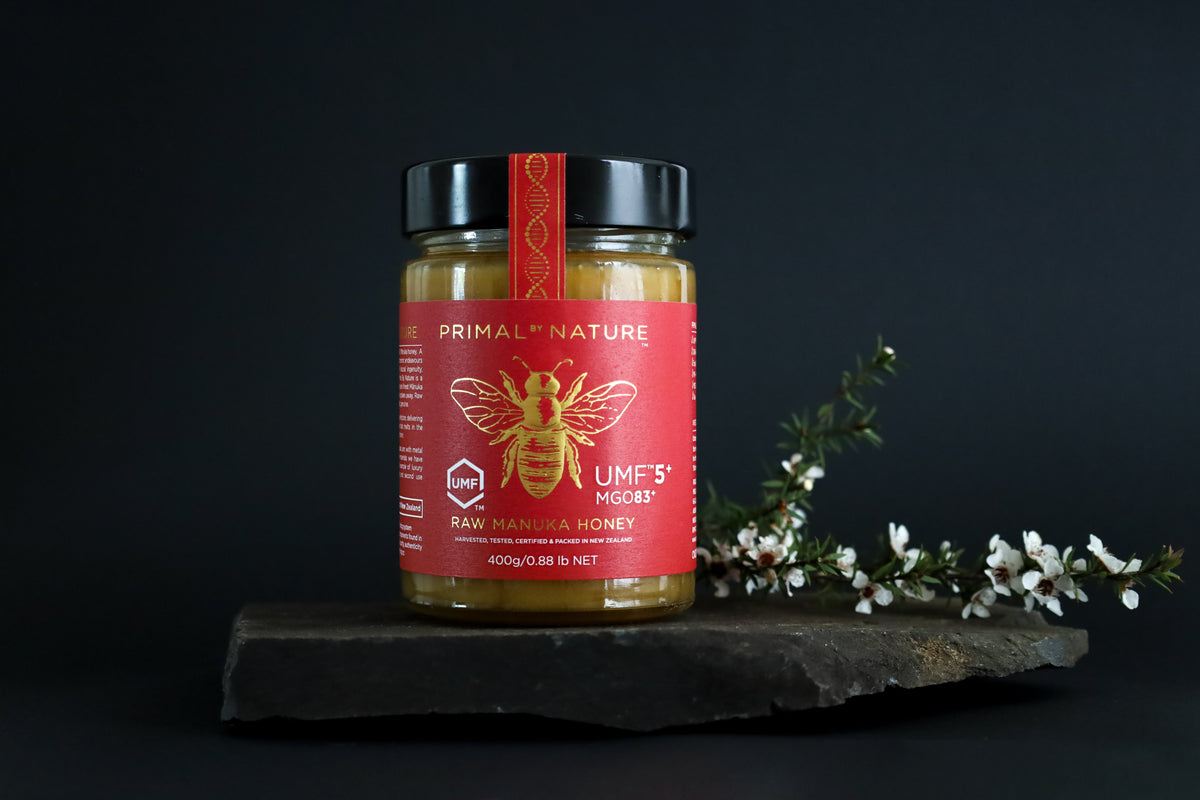
- There is no single highest MGO Mānuka honey: the UMF reference scale runs to 25+, and larger MGO-only numbers don't carry the same independent checks.
-
UMF is a complete certification, MGO is one of its four markers, so a higher MGO number describes concentration - while a UMF licence reveals what’s behind it.
Two jars of Mānuka honey sit side by side. One label reads UMF™ 15+. The other reads MGO 1000+. Which is stronger? It’s a fair question, and the one most buyers ask first.
Many begin by searching for the highest MGO Mānuka honey, expecting one clear winner. The honest answer starts with a simple fact: the two labels are not measuring the same thing. Once you know how they fit together, the search stops being a race to the biggest number. It becomes a question of what you can trust.
This guide gives you a plain answer, and a simple method you can use on any jar, whether you are buying for yourself or choosing a gift.
What Are UMF™ and MGO in Mānuka Honey?
The short version of "what is UMF and MGO in Mānuka honey" is this: MGO is one of the four markers, and UMF™ is the whole certification.
MGO, or methylglyoxal, is measured in mg/kg and shows concentration. Leptosperin is an authenticity marker. DHA and HMF relate to how the honey develops and how fresh it is. Licensed companies must have their honey independently tested before a grade can appear on a jar, so the label reflects a laboratory result and not a claim.
MGO is absent from fresh nectar. It forms after harvest as DHA converts, so it’s measured in the finished honey. Think of it this way: MGO is one line on a report. UMF™ is the whole report. For the formal definition, read why UMF™ and scientific definitions matter. Think of it this way: MGO is one line on a report. UMF™ is the whole report.
For the formal definition, read why UMF™ and scientific definitions matter.
Shoppers who ask what is UMF™ in Mānuka honey often want the next answer too: how the grade relates to the MGO number. Each UMF™ grade carries a minimum MGO level. The following table shows four common grades, including the popular Mānuka honey UMF™ 15+ and UMF™ 20+.
|
UMF™ grade |
Minimum MGO (mg/kg) |
|
UMF™ 5+ |
83 |
|
UMF™ 10+ |
263 |
|
UMF™ 15+ |
514 |
|
UMF™ 20+ |
829 |
Some MGO-only labels print larger numbers still. Without a licence, those figures don’t carry the same independent checks, so they cannot be compared directly with a UMF™ grade.
Some brands report MGO on its own, with their own limits and testing arrangements. That is a reason to ask who tested the honey, not a reason to dismiss the number. This matters most for gift buyers, because a gift should carry a label that the recipient can check.
People who search for the ‘strongest’ Mānuka honey usually mean the greatest concentration of MGO. If you’re wondering what is the highest UMF™ rating for Mānuka honey, the reference scale ends at around UMF™ 31+.
High grades are rare and they cost more, for three reasons. The Mānuka bloom is short. DHA varies with each plant's genotype, not with geography or environmental stress. And MGO develops only after harvest, so the result cannot be guaranteed in advance.
So, the strongest Mānuka honey on paper is not automatically the one you can verify. A higher number describes concentration. Certification confirms what the number is attached to. Not sure which grade suits you? Our guide to the UMF grades explains each one, from UMF™ 5+ to the top of the range.
How Do You Judge a Premium Jar by Its Certification?
A search for Mānuka honey highest MGO returns many large numbers. A short checklist lets you judge any jar yourself. Look for these five things:
-
A UMF™ trademark with a licence number that you can check with the UMF Honey Association.
-
A grade that matches its stated MGO figure.
-
Compliance with the MPI Mānuka honey science definition, which uses four chemical markers and one pollen DNA marker.
-
Packed at a single source in New Zealand, with batch traceability.
-
Independent laboratory testing, rather than testing by the seller alone.
Each point can be confirmed in a few minutes, using the label and the websites of the licensing and government bodies. The MPI definition and UMF™ are two different checks. The MPI definition is a government requirement for export, while UMF™ is a separate, voluntary licence that adds grading.
One note of caution: an MGO figure with no licence behind it cannot be compared with a UMF™-graded jar. It might be accurate, but you’ve got no independent way to confirm it. For the fuller authenticity picture, learn how to read a Manuka honey label.
How Does Primal by Nature Approach Grade and Certification?
Primal by Nature is UMF™ licensed. Its honey passes the MPI Mānuka honey science definition (monofloral licence #MAL01/01), and the business is SQF certified. Every batch is independently tested in IANZ-certified laboratories, and results are checked against both brand and customer specifications. You can read more about how quality control delivers luxury Mānuka honey.
The honey is raw and unpasteurised: nothing added, nothing taken away. Each jar is packed at a single source and presented in recyclable glass. The same standards have earned recognition for award-winning Mānuka honey.
The range is a choice of grades, not a race to the top. Some buyers choose a grade for everyday use. Others choose one for gifting or collecting. Whichever you choose, the certification behind it stays the same.
The Short Answer
There is no single jar or number that settles the question. The highest number is only the start of the label, and certification is what gives it meaning.
Check the licence, match the grade to the MGO figure, and look for independent testing. That is the whole method. It works on any jar, for any buyer.
Then explore our UMF™-graded Mānuka honey and choose your grade with confidence.


