

Mānuka honey is one of the most counterfeited foods in the world, which is why New Zealand backs it with a government science definition and an independent certification system, UMF.
Together, they verify that a jar is genuinely monofloral, accurately graded and honestly labelled - protections that matter most at the premium end of the market, where the incentive to imitate is greatest.
What Is The Scientific Definition of Mānuka Honey?
Mānuka honey has a legal, government-set scientific definition because it’s unique to New Zealand and highly valuable - without one, any honey could be marketed as "Mānuka." New Zealand's Ministry for Primary Industries (MPI) requires monofloral Mānuka honey to test positive for five specific chemical and DNA attributes.
This isn’t a marketing standard - it's a regulatory one, administered by the New Zealand Government, and it exists because Mānuka honey's rarity and reputation created an obvious incentive for imitation. The definition draws a firm, testable line between honey that genuinely originates from the Mānuka flower and honey that simply borrows its name.
To meet MPI's science definition, a sample must show four chemical markers at defined concentrations:
3 mg/kg -Phenyllactic acid
2 mg/kg -Methoxyacetophenone
2 mg/kg -Methoxybenzoic acid
4 mg/kg -Hydroxyphenyllactic acid
These are measured alongside a fifth marker - the DNA compound leptosperin, which is found only in the nectar of the Mānuka tree.
All five attributes must be present in order for the honey to meet the definition. A sample that fails even one is reclassified as multifloral, regardless of how the product is marketed or what its label claims. There’s no such thing as a partial pass. Any honey exported from New Zealand under the Mānuka name must be tested against this standard by an MPI-recognised, independent laboratory before it can legally carry the claim.
For a full walkthrough of how these markers appear on an actual product label, see our guide to reading a Mānuka honey label.
What is MGO and What Does It Actually Measure?
MGO - methylglyoxal - is the naturally occurring compound that’s responsible for Mānuka honey's antibacterial activity, and its concentration, measured in mg/kg, indicates potency. But MGO is only one variable. On its own, it cannot confirm that a honey is monofloral, genuinely sourced or independently verified.
MGO forms through a natural conversion process. Dihydroxyacetone (DHA), found in the nectar of the Mānuka flower, converts into methylglyoxal as the honey matures. The resulting concentration is what gives Mānuka honey its distinctive, non-peroxide antibacterial character - a property that’s found at meaningful levels in no other honey.
This is also where the market becomes easy to misread. MGO figures appear on many labels as a standalone number and a higher figure understandably reads as a stronger product. But MGO measures potency alone. It says nothing about whether the honey is monofloral, where it was genuinely sourced, or whether the figure on the label has been independently verified by anyone other than the seller.
A jar can display an MGO number with no third-party testing behind it at all.
Concentrations will vary considerably by batch and season, and very high MGO figures are genuinely rare - which is precisely why they command a premium.
This is why the right question to ask whenever you’re buying Mānuka honey isn’t simply "how high is the number," but "who verified it and against what." That is the gap that UMF was built to close.
Why is UMF the Gold Standard?
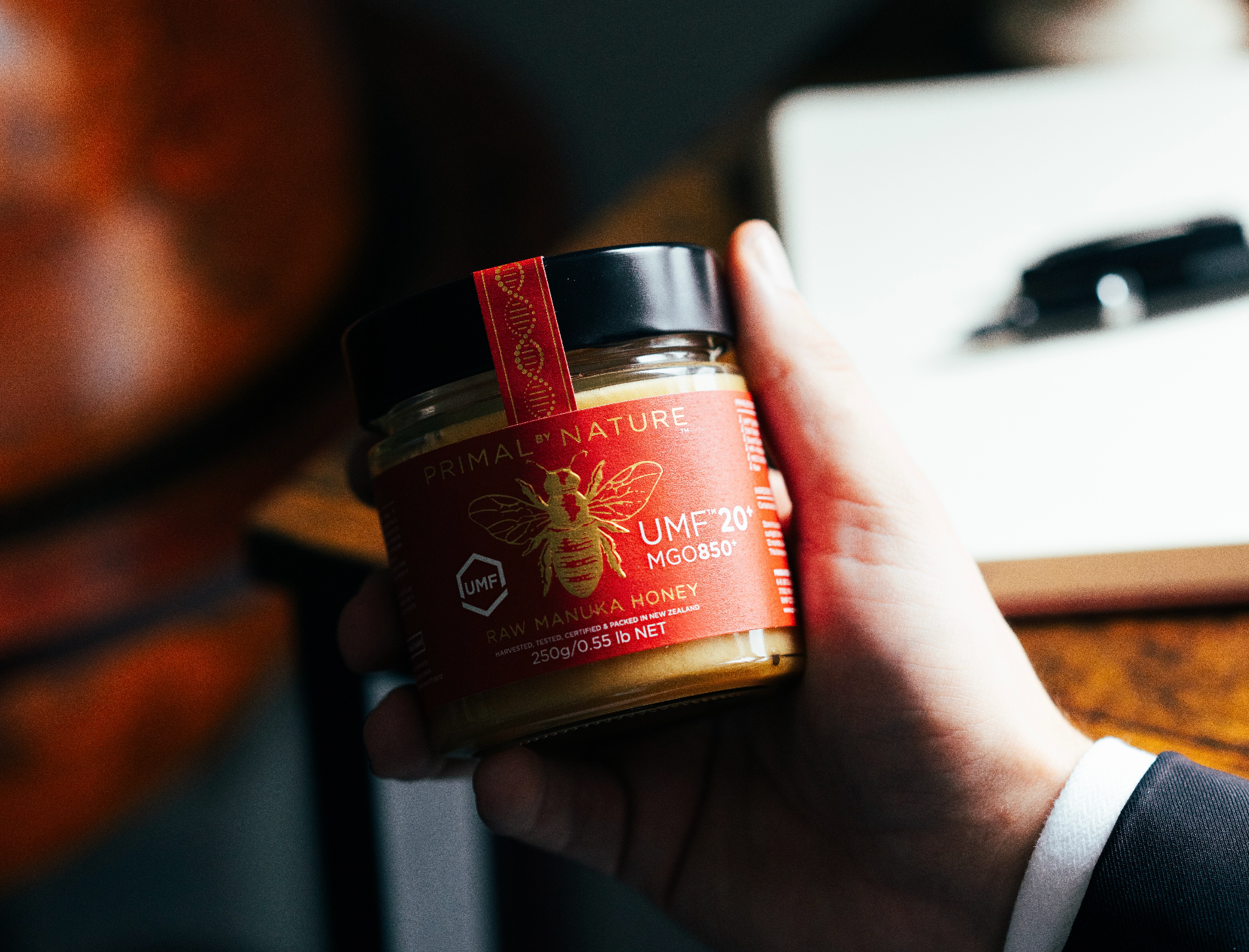
UMF - Unique Mānuka Factor - is a registered trademark administered by the UMF Honey Association (UMFHA) that verifies Mānuka honey through three compounds together, rather than potency alone: leptosperin, DHA and MGO. Only licensed producers can display it and each licence is tied to a verifiable number.
Where an MGO figure in isolation tells you only about potency, UMF requires all three markers to meet defined thresholds simultaneously:
Leptosperin confirms floral authenticity, proof the honey genuinely originates from the Mānuka flower.
DHA indicates freshness and the honey's ongoing potential to develop MGO over time.
MGO measures potency, the same compound seen on standalone labels, but it’s now verified alongside the other two.
A rating can’t be achieved through MGO alone. This is what makes UMF a more complete verification than any single-compound figure, and why it’s regarded internationally as the benchmark certification for genuine Mānuka honey.
Every legitimate UMF label carries a licence number that can be cross-checked against the UMFHA's published licensee database, confirming the claim on the jar is current and authorised. For the complete process of verifying a licence number against a specific label, see our guide to reading a Mānuka honey label.
Why Does This Framework Matter For Buyers?
Because Mānuka honey is scarce and commands a significant premium, it’s one of the most imitated foods in the world - independent estimates suggest more ‘Mānuka’ honey is sold globally each year than New Zealand could plausibly produce. MPI's science definition and UMF certification are what allow a buyer to tell genuine, potent, single-origin honey apart from an unverifiable claim.
But don’t be alarmed; this is the reason certification exists. New Zealand's response to a high-fraud category wasn’t to leave buyers to guess, but to build a regulatory and scientific framework precise enough that authenticity could be proven rather than simply asserted.
For a premium buyer, this framework is what the price is actually paying for. A jar of genuinely monofloral, UMF-certified Mānuka honey represents a finite harvest, a rigorous testing regime and an independently verified result - not simply a label design or a number chosen for shelf appeal.
How Primal by Nature Meets This Standard
Every one of Primal by Nature’s Mānuka honey jars are 100% monofloral, MPI-certified, UMF licensed and independently tested in IANZ-certified laboratories - regardless of grade and always presented in glass.
Our monofloral certification is held under MPI licence #MAL01/01 and our production facility is recognised under MPI's Risk Management Programme (RMP) as a certified food production facility by the New Zealand Government. We also hold SQF certification, an internationally recognised food safety and quality benchmark shared by only a small number of Mānuka honey producers worldwide.
Every batch is independently tested in IANZ-certified laboratories, with results validated against both our own brand specifications and the requirements of the relevant export market before any jar reaches a customer.
This standard has been recognised with award-winning results at international honey competitions - independent validation of a standard we hold ourselves to regardless of external recognition.
Every jar is packed from a single source, ensuring full traceability from hive to shelf and presented in glass - a packaging choice that reflects both the premium nature of the product inside and our broader commitment to sustainability.
To understand more about where this honey comes from and why New Zealand's environment cannot be replicated elsewhere, read how New Zealand produces coveted Mānuka honey.
To explore the full range, shop Primal by Nature's UMF certified Mānuka honey.
Frequently Asked Questions
What is the MPI scientific definition of Mānuka honey?
A government-set test requiring five specific chemical and DNA markers to be present before honey can be certified as monofloral Mānuka.
What's the difference between MGO and UMF™?
MGO measures one compound - potency. UMF™ verifies three, leptosperin, DHA and MGO together, giving a fuller picture of authenticity, freshness and potency.
Is UMF better than an MGO-only rating?
UMF is more rigorous because it cannot be satisfied by potency alone; it also confirms floral authenticity and freshness, which an MGO figure alone cannot do.
Why is Mānuka honey so heavily counterfeited?
Its scarcity, unique origin and premium pricing create a strong incentive for imitation, which is why independent, government-backed verification exists.
Does Primal by Nature honey meet the UMF and MPI standards?
Yes. Every jar is UMF™ licensed, MPI monofloral certified (#MAL01/01) and independently tested in IANZ-certified laboratories.
Where can I check a UMF licence number?
Against the UMFHA's published licensee database. For a full label-verification walkthrough, see our guide to reading a Mānuka honey label.


