

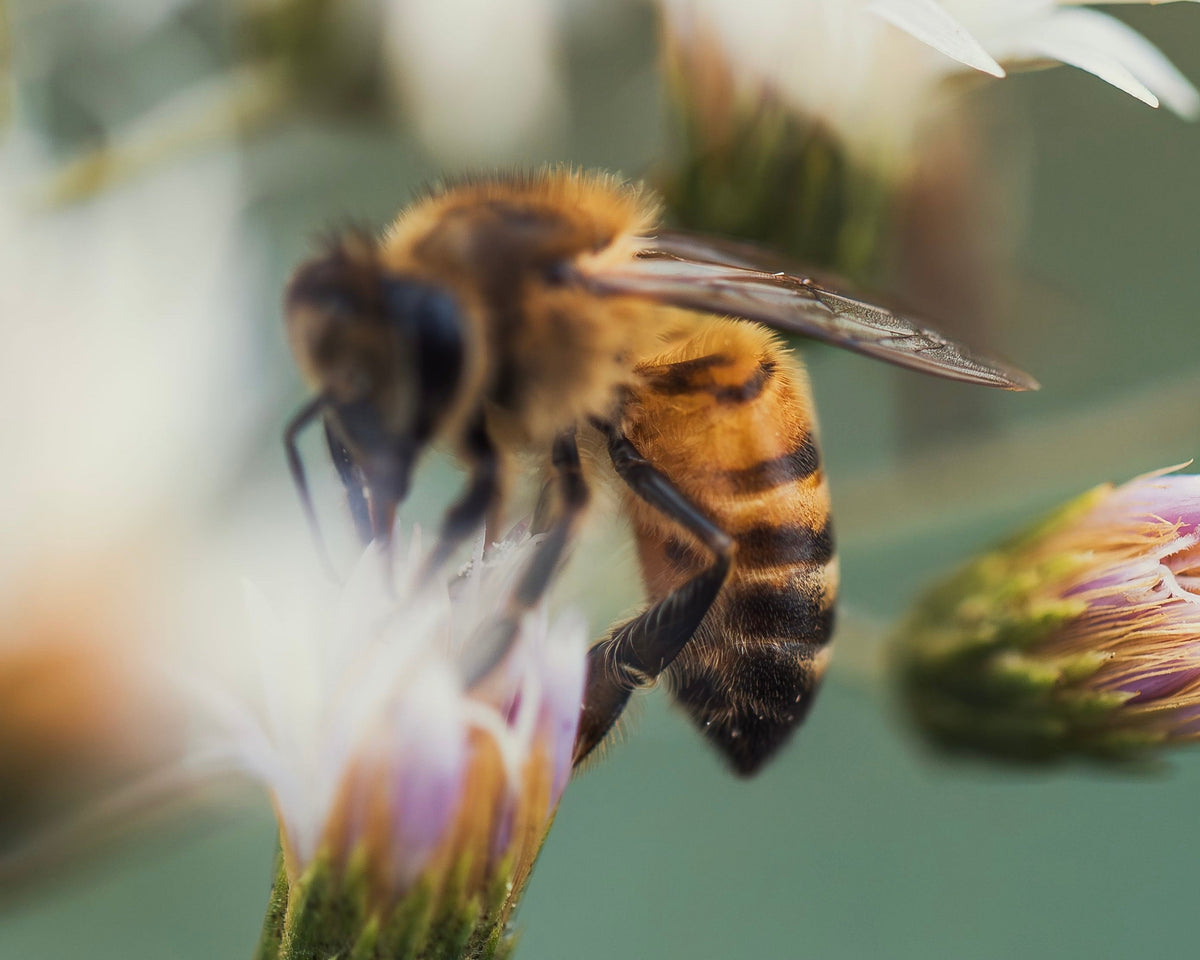
Each summer, for a few short weeks, the Mānuka tree blooms across New Zealand's hillsides and valleys - and the entire year's honey harvest depends on what happens between flower and bee during that window.
Everything Primal by Nature has told you about UMF ratings and MGO grading starts here, with a botanical process most people never think to ask about. Before there's a number on a jar, there's a flower doing the real work - and bees that are busy delivering a rare treat of nature.
This is the science behind the certification: what actually makes Mānuka honey different, at the source.
The Rare Source of Mānuka
The Mānuka flower itself is unassuming - small, five-petalled, white fading to pale pink at the centre, blooming in dense clusters for a brief window each New Zealand summer. Miss it, and you’ll be waiting another year.
What matters isn't how the flower looks. It's what's happening inside it and the fact that this isn't consistent across every plant. Not every Mānuka produces the nectar chemistry that honey producers depend on, and not every related species carries it at all. Of the many species of tree found across New Zealand, only some generate nectar rich in the compound that ultimately defines genuine Mānuka honey.
In practical terms, this means genuine Mānuka honey depends on genetics that vary from plant to plant, decided long before any bee arrives. The flower either has the right composition or it doesn't, and no amount of skilled beekeeping changes that.
It begins with the compound dihydroxyacetone, or DHA - a simple sugar that builds up in Mānuka nectar at levels rarely found elsewhere. It's produced inside the flower's own nectary tissue, and recent research has traced this even further back to photosynthesis happening within the nectary itself, which feeds the sugar production that becomes DHA.
Here's the key part: DHA on its own isn't antibacterial. It sits within the nectar chemically inactive, waiting for a transformation that hasn't happened yet. A flower rich in DHA hasn't produced anything special yet - it's produced the raw material for something that will only take shape later, once bees have gathered it and the honey has had time to mature.
It's also worth clearing up a common assumption. It's easy to think that Mānuka growing in tougher conditions - exposed hillsides, poor soil, harsher microclimates - produces stronger nectar, as if difficulty translated into potency. But the evidence doesn't back this up.
Variation in DHA between plants comes down mainly to genotype - the genetic makeup of the individual plant - not how hard its growing conditions are. Some Mānuka plants are simply genetically predisposed to produce high-DHA nectar; others, in identical conditions, aren't. Location tells you where the flower is growing. It doesn't tell you what's in its nectar.
The Bee’s Role In The Process
None of the above is down to the bee, and it's worth being straightforward about that. Bees aren't seeking out Mānuka flowers because they can somehow detect DHA content - there's no evidence bee foraging behaviour works that way. A foraging bee wants what any bee wants: nectar for energy, pollen for protein. Mānuka flowers, blooming in dense clusters over a short season, offer plenty of both at a time when few other native sources are competing for attention. That's the extent of the bee's motivation.
The actual decision-making sits with the beekeeper, not the bee. This is where Primal by Nature's approach to hive placement comes in.
Rather than trying to manage or influence bee behaviour directly, hives are placed in remote hilltop and valley sites across New Zealand, specifically because Mānuka plants known for producing high-DHA nectar will grow there. The important choice happens before the bees are ever released to forage - in choosing the location, not in controlling the insects.
After that, the bees simply do what bees do, largely undisturbed, while the plant's own genetics do the rest. It's a straightforward division of labour; the honey isn't the result of engineering the bee. It's the result of putting bees somewhere the flowers were already going to do their part.
Once nectar becomes honey, the process isn't finished. DHA is an unstable compound and over time, through storage and maturation, it converts, non-enzymatically, into methylglyoxal, or MGO. This is the compound actually responsible for Mānuka honey's distinctive non-peroxide antibacterial activity, and the one that underpins the UMF rating.
This conversion isn't something bees do, and beekeepers don't perform it either - it happens on its own, gradually, as the honey sits and matures, with DHA steadily giving way to MGO over a period of months.
It's part of why freshly harvested Mānuka honey is tested, and sometimes matured further, before final grading. A newly harvested batch is, quite literally, still changing. The figure that eventually appears on a jar reflects a process that continues well after the bees have finished their work.
But DHA and MGO aren't the only compounds that matter here. Leptospermum scoparium nectar also contains leptosperin - which, unlike DHA or MGO, carries through into finished honey without converting into anything else. Its value is different: because leptosperin is specific to genuine Mānuka nectar, it's used by laboratories as an authenticity marker, helping confirm that a jar of honey actually came from Mānuka, rather than Kānuka or a blended product sold under the Mānuka name.
A more recently identified compound, Lepteridine adds another layer of species-specific verification, and continues to be studied for what else it might reveal about Mānuka's distinctive chemistry. These are exactly the kinds of markers that are tested within Primal by Nature's IANZ-certified laboratories - a level of scrutiny made possible only because the flower itself produces compounds nothing else quite replicates.
Why This Matters at the Jar
Put it all together and the picture is fairly simple. Every jar of Primal by Nature Mānuka honey carries a genetic and chemical inheritance that starts in the flower, well before a bee arrives, a beekeeper makes a placement decision, or a laboratory runs a test.
DHA content was set by genotype. The bee did what bees always do. MGO developed slowly, as the honey matured. And the authenticity markers that confirm all of it were present in the nectar from the beginning.
This is exactly why single-source, non-blended, rigorously tested honey is central to how Primal by Nature operates. The quality of Mānuka honey isn't something a producer can add after the fact - it's determined by the flower.
What a producer can do is protect it, test for it, and refuse to compromise it with blending. Everything else was already decided in the bloom.


