

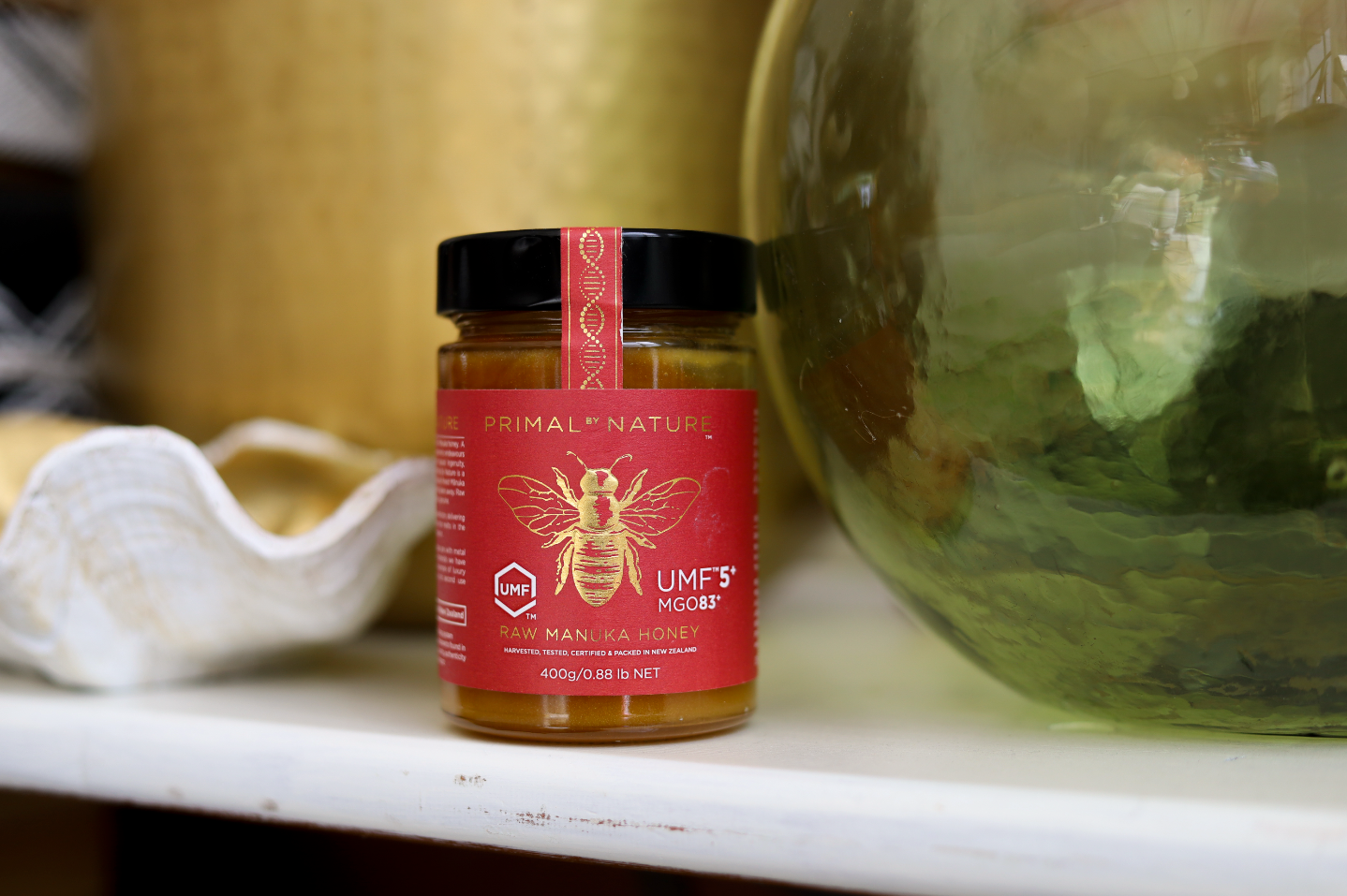
How To Read The Label:
- Look for the UMF™ trademark and a corresponding licence number
-
This is confirmation that the honey is packed in New Zealand, holds MPI monofloral certification and meets independent laboratory testing credentials.
Mānuka honey is one of the most counterfeited foods on the planet. Global demand for authentic New Zealand Mānuka honey vastly outstrips the volume that New Zealand's limited Mānuka forests can genuinely produce - which means imitation products, mislabelled blends and unverifiable claims are abundant on the market.
For the discerning buyer, the label is the first and most critical line of defence. This guide decodes every element you are likely to encounter - from UMF™ grades and MGO values to monofloral certification and SQF accreditation - so that your next purchase is made with complete clarity and confidence.
For a broader overview of selecting the right product for your needs, visit the Primal by Nature buying guide.
The UMF Trademark: The Gold Standard of Mānuka Certification
UMF - Unique Mānuka Factor - is a registered quality trademark owned and administered by the UMF Honey Association (UMFHA), the independent body that sets and enforces the global standard for Mānuka honey certification. Only producers who hold a current UMFHA licence are legally permitted to display the UMF trademark on their product.
The UMF system measures three signature chemical compounds to verify both the authenticity and potency of Mānuka honey:
Leptosperin - a naturally occurring compound found exclusively in the nectar of Leptospermum scoparium, the Mānuka tree.
DHA (dihydroxyacetone) - a precursor compound derived from Mānuka nectar. DHA converts to methylglyoxal over time; its concentration reflects the honey's freshness and genuine Mānuka origin.
MGO (methylglyoxal) - the principal antibacterial compound in Mānuka honey, and the most widely recognised marker of potency.
Together, these three compounds form a multi-layered verification framework. A UMF rating cannot be achieved by testing MGO alone - all three markers must meet the required thresholds for the corresponding grade.
How to Verify a UMF License Number
Every legitimate UMF label will display a licence number alongside the trademark. This number is a verifiable identifier registered with the UMFHA. Buyers can cross-reference any producer's licence against the UMFHA's published licensee database, confirming that the UMF claim on the label is current and authorised.
Primal by Nature is a fully licensed UMF producer. Every jar carries verifiable certification - a traceable, independently verified credential.
Understanding MGO
Methylglyoxal (MGO) is a naturally occurring compound responsible for Mānuka honey's renowned antibacterial properties. It forms within the honey over time as DHA - present in the Mānuka flower's nectar - undergoes a natural conversion process. The higher the MGO concentration, the greater the honey’s potency.
MGO values do appear on some Mānuka honey labels as a standalone rating system. It’s important to understand what this means - and what it does not.
MGO measures a single variable. It can’t confirm whether a honey is monofloral, it also can’t verify its provenance or authenticate its Mānuka origin. It’s also important to note that a honey product can display an MGO figure without any independent third-party verification of those claims.
UMF, by contrast, encompasses MGO within a broader framework that also tests for Leptosperin and DHA - which provides a far more complete and trustworthy picture of the product.
|
UMF Grade |
Minimum MGO (mg/kg) |
Typical Use |
|
UMF 5+ |
83 mg/kg |
General Daily Use |
|
UMF 10+ |
263 mg/kg |
Mid-Grade Health & Skincare |
|
UMF 15+ |
514 mg/kg |
Premium Gifts |
|
UMF 20+ |
829 mg/kg |
Collector Honey |
Monofloral vs Multifloral - What the Label Doesn’t Always Tell You
Not all Mānuka honey is equal - and not all Mānuka honey is monofloral. This distinction is one of the most significant on any label, yet it is frequently misunderstood or obscured.
Monofloral Mānuka honey is produced predominantly from the nectar of the Leptospermum scoparium tree. Under New Zealand's Ministry of Primary Industries (MPI) science definition, a honey must pass five specific chemical attribute tests to be certified as monofloral. If a sample fails even one of those five tests, it is classified as multifloral - a blend of Mānuka and other floral sources - regardless of how it might be marketed.
Monofloral Mānuka honey is rarer. The Mānuka tree flowers for only a matter of weeks each year and the conditions required for high-grade monofloral production - remote, pristine locations free from agricultural interference - are finite. This scarcity is reflected in both the price and the prestige of genuinely monofloral product.
Primal by Nature's honey is 100% monofloral, certified under MPI licence #MAL01/01 and passes all five required science definition attributes. To understand more about the origins of our honey and what makes New Zealand provenance so significant, read about our origins and crafting process.
Be aware that some products on the market carry the “Mānuka” name without monofloral certification. Always check the label for explicit monofloral status and the relevant MPI compliance reference.
Other Certification Marks to Look For
Beyond UMF and monofloral status, a best-in-class Mānuka honey label will carry additional certification marks that speak to a producer's food safety standards, export compliance, and laboratory rigour.
MPI Certification
The New Zealand Ministry of Primary Industries (MPI) is the government body responsible for regulating Mānuka honey production and export. Producers who hold a Risk Management Programme (RMP) certification with MPI are recognised as certified food production facilities by the New Zealand Government - a requirement for legitimate export to international markets.
Primal by Nature is MPI-certified and RMP-compliant, meeting every legal standard required for the global export of premium Mānuka honey.
SQF Certification
SQF - Safe Quality Food - is an internationally recognised food safety and quality standard, and a prerequisite for supplying the majority of global food retailers. It’s one of the most rigorous benchmarks in the food production industry.
Primal by Nature holds SQF certification - a distinction shared by only a handful of Mānuka honey producers worldwide. For buyers and distributors evaluating suppliers, SQF certification is a meaningful differentiator that signals not just product quality, but systemic operational excellence.
IANZ-Certified Laboratory Testing
IANZ - International Accreditation New Zealand - accreditation means that a laboratory's testing practices have been independently assessed against international standards of precision and reliability. It’s the assurance that the numbers on the label are not self-reported; they are the product of rigorous, third-party scientific analysis.
Every batch of Primal by Nature's Mānuka honey is tested in independent IANZ-certified laboratories. Results are validated against both brand specifications and the requirements of the relevant export market before any jar reaches a consumer.
UMF Grade Guide Which Number Should You Choose?
The UMF number on a label directly corresponds to the concentration of the three key compounds - Leptosperin, DHA, and MGO - within that batch of honey. A higher number reflects greater potency and purity, not simply a higher price point.
UMF 5+ (83mg/kg MGO): The entry grade. Accessible and versatile, suited to those exploring Mānuka honey for the first time or incorporating it into everyday routines.
UMF 10+ (263mg/kg MGO): A step up in intensity. The preferred choice for regular daily use among those who value elevated potency without reaching for the premium tier.
UMF 15+ (514mg/kg MGO): The prestige grade. Primal by Nature's flagship product, recognised with a Gold Award at the London Honey Awards for its exceptional quality in this category. At this level, the purity and intensity of the honey are unmistakably distinct. It’s the preferred choice for discerning consumers and premium gifting.
UMF 20+ (829mg/kg MGO): Ultra-premium. Reserved for those who seek the absolute apex of Mānuka honey's potency and purity - a collector's grade.
The correct grade for any individual depends on intended use and personal preference. Those drawn to Mānuka honey for its distinctive character and premium provenance will find UMF 15+ the most considered and rewarding choice.
What a Fake Label Looks Like
The Mānuka honey industry is, by any measure, a high-fraud category. Independent analyses have estimated that the volume of honey sold globally as "Mānuka" exceeds what New Zealand's Mānuka forests could plausibly produce - in some estimates, by a factor of several times over.
The UMF trademark is legally protected; its misuse constitutes a breach of intellectual property law, not merely a misleading claim. Despite this, imitation products persist.
Before purchasing any Mānuka honey, always check the following:
✓ The UMF trademark is present - not a lookalike phrase or generic grading system
✓ A UMFHA licence number appears on the label
✓ The honey is stated as packed in New Zealand (not merely "produced" or "sourced" there)
✓ Monofloral status is explicitly declared with an MPI certification reference
✓ Independent laboratory testing is referenced or verifiable
✓ No unsubstantiated therapeutic or medical claims appear on the label
Always treat with scepticism:
✗ Labels with high MGO numbers but no UMF trademark or licence number
✗ Products packed outside New Zealand
✗ Vague provenance language ("New Zealand-style" or "Mānuka blend")
✗ Unusually low price points for claimed high-grade honey
✗ Medical or curative claims, which are not permitted under UMFHA licensing standards
What Primal by Nature's Label Tells You
A well-constructed Mānuka honey label functions as a transparent record of everything that has happened to that honey - from the hive to the jar. Primal by Nature's label is designed precisely to this standard.
Every jar carries the UMF trademark and corresponding UMFHA licence number. MPI monofloral certification (#MAL01/01) confirms regulatory compliance with New Zealand's government-mandated science definition. SQF certification speaks to the operational standards of the production facility. IANZ-certified laboratory results validate the UMF™ grade stated on every batch.
The honey itself is packed at a single source in New Zealand - one location, traceable from beginning to end. Our ethical beekeeping practices and the full story of the cultural significance of the Mānuka tree are part of the same unbroken chain of accountability.
What the label does not contain is equally important: no additives, no blending, no pasteurisation. Nothing added, nothing taken away.
This is what best-in-class looks like: a verifiable, independently certified product. Shop Primal by Nature’s full product range.


