

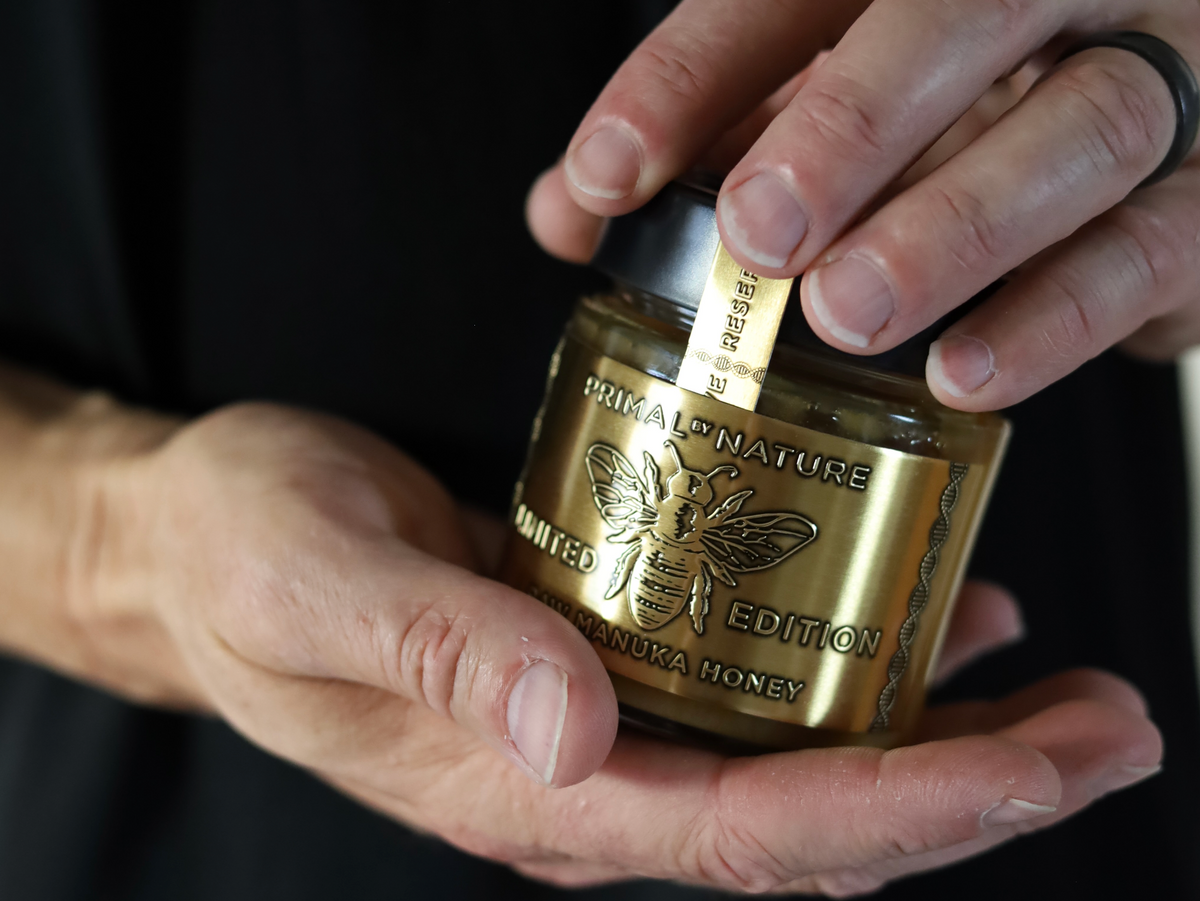
- Genuine Mānuka honey costs more because it comes mainly from one native New Zealand tree that blooms for only a few weeks each year.
- Every jar exported as Mānuka honey must be independently tested, and that proof is part of what the price pays for.
Two jars of honey sit side by side. One is a familiar everyday honey. The other is Mānuka honey, and it costs several times more. Both are honey, so why is Mānuka honey so expensive? It’s a fair question, and a sensible one to ask before you buy. The answer isn’t in the marketing. It is a flower that blooms for only a few weeks, a harvest that cannot be increased and a standard of proof that everyday honey is never asked to meet.
Set Mānuka honey vs normal honey side by side, and the price gap begins to make sense. It comes down to four things: the flower, the season, the proof and the handling.
The Difference Between Mānuka Honey and Normal Honey
Normal honey usually comes from the nectar of many flowers and often blended, filtered and heated for a clear, consistent product. Monofloral Mānuka honey comes mainly from one native New Zealand tree, contains naturally formed MGO, and is independently tested against a government science definition before it is exported.
Most everyday honey is multifloral. Bees gather nectar from whatever happens to be flowering nearby, and much of the honey on supermarket shelves is blended from several sources. It’s often heated and finely filtered so it stays clear, runny and consistent from jar to jar. We’re talking about a good, honest food, and it has a place in every kitchen.
Mānuka honey begins with a single tree. The nectar of Leptospermum scoparium, native to New Zealand, contains a natural compound called dihydroxyacetone (DHA). There is no detectable methylglyoxal (MGO) in the nectar itself. As the honey matures after harvest, the DHA slowly converts into MGO, as research from the University of Waikato has shown. In one widely cited study, Mānuka honey contained up to 100 times more MGO than conventional honeys.
That is the heart of the Mānuka honey vs normal honey question. One is shaped by convenience and scale. The other is shaped by a single flower - and that’s where the price begins.
Why Does Monofloral Mānuka Honey Cost More to Produce?
Monofloral Mānuka honey is honey that comes mainly from the Mānuka flower. That has been proven over the years through testing against New Zealand’s government science definition for Mānuka honey, which uses four chemical markers and one marker of Mānuka pollen DNA. Honey that meets the Mānuka markers, but not the higher monofloral thresholds, is classed as multifloral Mānuka honey. It’s still genuine Mānuka honey, blended with nectar from other flowers, and it’s been priced accordingly.
You can see how this status appears on a jar in our guide on how to read a Mānuka honey label.
Producing it is limited by nature at every step. The Mānuka tree blooms for only a few weeks each year, typically between two and six. The weather in that short window decides the entire season’s harvest. Hives need to sit where Mānuka dominates the landscape, which often means the hives are places in the remote hills and valleys of rugged North and South Island terrain. Some sites can only be reached by helicopter.
The flower adds one more limit. DHA levels in the nectar vary from plant to plant, and recent genetic research points to the plant’s own genetics as a key influence. In a controlled study of Mānuka plants, drying soil had no effect on nectar composition. Not every Mānuka plant produces high-DHA nectar, and no amount of effort changes that. For a closer look at what happens inside the flower, read what makes a bee choose Mānuka honey.
Supply is finite, and it’s set by the flower. That’s the first part of the price.
How Does Independent Certification Add to the Price?
Any honey that’s exported from New Zealand as Mānuka honey must first be tested by an MPI-recognised laboratory. Each batch is checked against the science definition before it can legally carry the Mānuka name overseas. For a fuller explanation read why UMF™ and scientific definitions matter.
UMF™ licensing adds a second layer. Licensed producers have each batch independently graded, and the grade on the label is tied to a licence number that can be checked. Normal honey is governed by food safety and labelling rules, but it has no comparable grading scale.
Testing, licensing and batch traceability are real costs, and they’re built into every certified jar.
Grade plays its part too. The more expensive Mānuka honey products are usually the rarer grades, because the highest concentrations are genuinely scarce in any harvest. To understand how rarity shapes each jar, read what the highest grades really mean.
This is also how real Mānuka honey is confirmed separately from clever packaging. A very low price on a high-grade claim, or a grade with no licence behind it, deserves a second look. So when people ask why is Mānuka honey so expensive, part of the answer is simple: proof costs money, and a genuine jar carries it.
Mānuka Honey vs Raw Honey: What Does “Raw” Really Mean?
Raw describes how honey is handled: not pasteurised. It says nothing about which flower the nectar came from, so raw honey can come from any source. Raw Mānuka honey combines both - the single-flower source and the independent certification of Mānuka with the gentle, unheated handling of raw honey.
The Mānuka honey vs raw honey comparison often causes confusion, because the two words describe different things. Mānuka describes where honey comes from. Raw describes how it’s treated once the product leaves the hive. Raw honey from any flower can be excellent, and it’s usually more affordable because its supply is far broader.
Raw Mānuka honey brings the two together. Handling matters because the heat changes the honey. It can alter flavour, aroma and texture, and it raises HMF - a freshness indicator measured in UMF™ testing. Gentle handling protects the honey’s natural character.
Mānuka honey also crystallises naturally over time. To give it that typically smooth and spreadable texture without pasteurising it, the honey needs to be gently creamed - stirred slowly at a low temperature over several days. You can learn more about how our honey is gently creamed.
|
Normal Honey |
Raw Honey |
Raw Mānuka Honey |
|
|
Floral Source |
Many flowers, often blended |
Any flower; “raw” describes the handling |
Mainly one native New Zealand tree |
|
Typical Handling |
Often heated and finely filtered |
Unpasteurised; lightly strained |
Unpasteurised; lightly strained; may be gently creamed |
|
Verification |
Food safety and labelling rules |
Food safety and labelling rules |
MPI science definition, plus UMF™ grading where licensed |
|
What Drives the Price |
Scale and year-round supply |
Smaller batches and careful handling |
A short bloom, remote sourcing, batch testing and certification |
What the Price of a Primal by Nature Jar Pays For
Every jar of Primal by Nature reflects all four parts of the price. Our honey is 100% monofloral Mānuka honey, certified (under MPI licence #MAL01/01). Our hives are placed in remote hills and valleys across New Zealand, where Mānuka plants dominate and the bees can work the brief bloom undisturbed.
Every batch is independently tested in IANZ-certified laboratories. Our honey is UMF™ licensed and SQF certified, and every jar is packed at a single source for full traceability from hive to shelf.
Our raw Mānuka honey from New Zealand is never pasteurised. It’s gently creamed for its signature velvety texture, then presented in glass, which protects the honey and can be reused or recycled. Nothing added, nothing taken away. It is the standard behind our award-winning honey, and it applies to every grade in the range, whether the jar is for your own table or chosen as a gift.
So Why Is Mānuka Honey So Expensive?
Genuine Mānuka honey costs more because supply is limited and proof is required. Bees must work one native tree during a bloom that lasts only a few weeks, often at remote sites. Every batch is then independently tested before it can be sold as Mānuka honey, and every grade on the label must be verified.
Everyday honey has its place, and it will always be a practical choice for the kitchen. Mānuka honey is for the moments when provenance matters: a quiet ritual of your own, or a gift chosen with care. Whether you are weighing Mānuka honey vs normal honey or Mānuka honey vs raw honey, you’re not simply comparing two prices. You’re actually comparing two very different journeys from flower to jar.
A rare flower, a short season, independent proof and careful handling. That is what the price of a genuine jar pays for. Explore our UMF™-graded Mānuka honey and choose the jar that suits your table, or your gift.


